
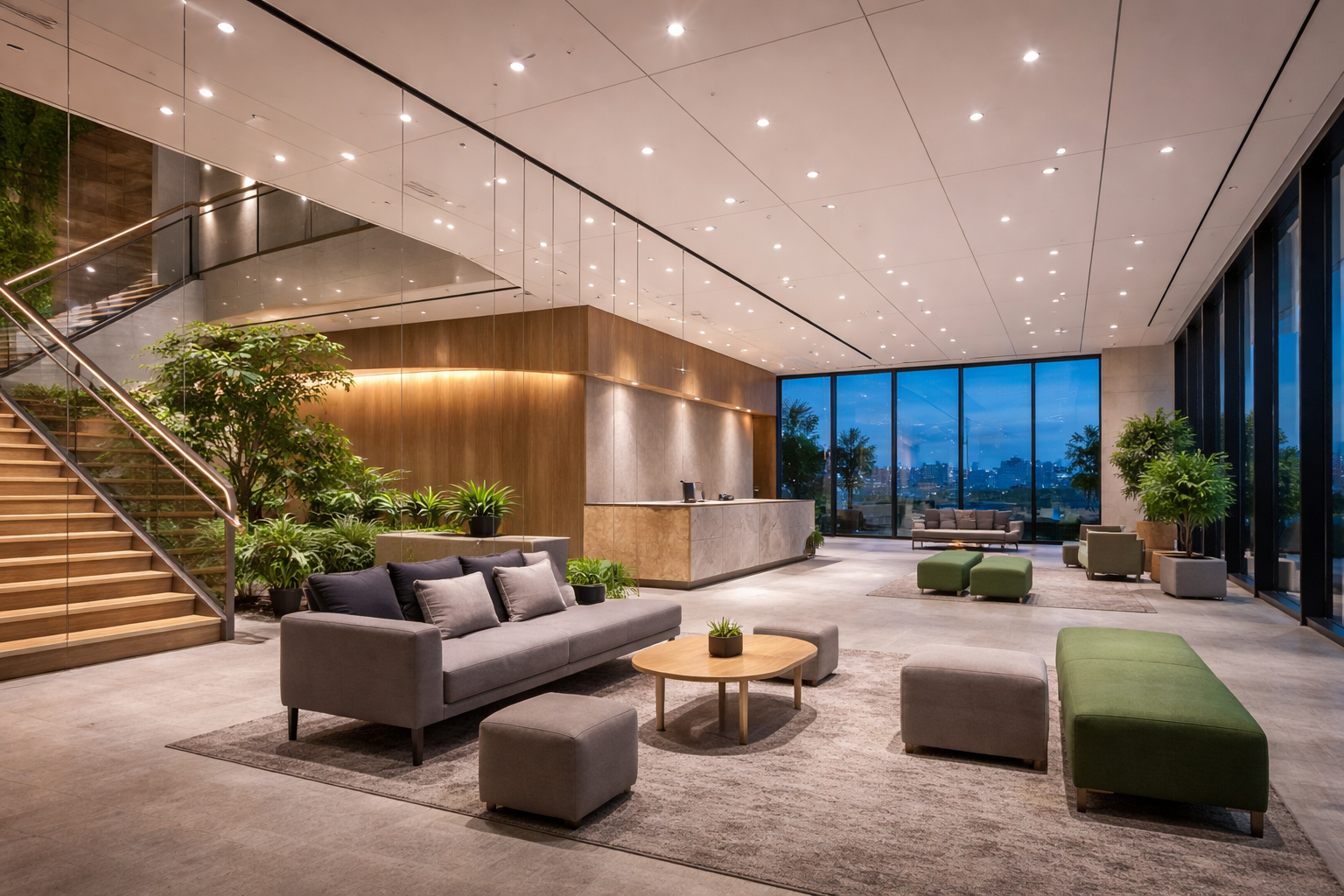
Modern infrastructure demands more than illumination. Commercial lighting solutions today function as performance systems that influence productivity, safety, energy efficiency, and long-term operational costs.
In commercial environments such as offices, hospitals, retail stores, industrial units, and institutional buildings, lighting directly affects user comfort and operational precision. Poor lighting can reduce productivity, increase fatigue, and elevate energy consumption.
Well-engineered Commercial lighting solutions combine technical calculations, energy modeling, fixture performance, and spatial understanding. Instead of simply installing lights, businesses now rely on structured planning approaches that ensure measurable performance outcomes.
This guide explains how commercial lighting works, how it is designed, and why strategic execution matters.
What Are Commercial Lighting Solutions and How Do They Differ from Standard Lighting?
Commercial lighting solutions are engineered lighting systems designed specifically for non-residential spaces where performance, compliance, and efficiency are critical.
Unlike residential lighting, commercial systems focus on:
- Precise lux level requirements
- Uniform light distribution
- Glare control (UGR standards)
- Long operational lifespan
- Energy code compliance
For example, office workspaces typically require 300–500 lux with minimal glare. Retail stores demand higher vertical illumination to enhance product visibility. Warehouses require uniform lighting for safety and accuracy.
These systems are calculated using photometric data and layout simulations to ensure consistency across large areas.
How Does Lighting Design Impact Productivity and Operational Efficiency?
Lighting directly influences human performance. In commercial environments, incorrect illumination can lead to visual fatigue, reduced concentration, and workplace errors.
Effective Commercial lighting solutions optimize:
- Visual clarity
- Color rendering accuracy
- Circadian rhythm support
- Task-specific illumination
For example, neutral white light (around 4000K) is commonly used in offices because it supports alertness. Industrial areas may require higher brightness for safety compliance.
From a technical standpoint, lighting design involves lumen output calculations, spacing ratios, reflectance analysis, and energy load estimation. Every fixture placement affects overall system efficiency.
When lighting is strategically planned, businesses experience lower maintenance costs and better energy performance metrics.
How Do Architectural Lighting Solutions Contribute to Modern Infrastructure?
Architectural lighting solutions are used to enhance structural identity and spatial depth while maintaining technical efficiency.
This approach is common in:
- Corporate facades
- Hospitality environments
- Institutional buildings
- Landscape lighting
Instead of only illuminating a space, architectural lighting enhances textures, materials, and design intent.
Technically, it involves:
- Beam angle precision
- Controlled shadow play
- Layered lighting techniques
- Contrast ratio balancing
When integrated correctly with commercial systems, it ensures that aesthetic appeal does not compromise energy performance.
What Role Does Professional Lighting Design Expertise Play?
Large-scale projects require detailed simulation and compliance-based planning. A professional Lighting design company in India, typically conducts:
- Lux level simulation using lighting software
- Fixture selection based on lumen maintenance
- Energy consumption modeling
- Electrical load balancing
Without proper planning, over-lighting or under-lighting becomes common, both of which increase operational costs.
Design expertise ensures:
- Optimized fixture count
- Reduced glare
- Consistent illumination
- Code compliance
In commercial projects, precision during planning prevents expensive retrofitting later.
How Do Suppliers Influence Long-Term Lighting Performance?
The reliability of fixtures and components directly affects the lifespan of lighting systems. Choosing a dependable Lighting solutions supplier in India ensures:
- Certified LED drivers
- Stable lumen output
- Thermal management efficiency
- Surge protection
In commercial installations, lighting systems operate for extended hours daily. Poor-quality components may fail prematurely, increasing maintenance costs.
High-quality suppliers provide technical documentation such as:
- Photometric reports
- LM-79 testing data
- Warranty specifications
Durability and electrical stability are essential for large institutional and industrial applications.
How Should Commercial Lighting Systems Be Maintained?
Maintenance planning is essential for preserving illumination performance. Even the best Commercial lighting solutions require monitoring.
Routine maintenance includes:
- Cleaning luminaires to prevent lumen depreciation
- Inspecting driver stability
- Checking voltage consistency
- Replacing emergency batteries
LED systems generally operate for 30,000–50,000 hours. However, environmental conditions and power quality influence longevity.
Monitoring energy usage trends also helps identify inefficiencies early.
Proper lifecycle management ensures consistent brightness and regulatory compliance.
FAQ Section
1. What lux level is ideal for office environments?
Offices typically require between 300 and 500 lux depending on task intensity. Meeting rooms may require adjustable lighting for flexibility.
2. Why is glare control important in commercial spaces?
Excessive glare reduces visual comfort and productivity. UGR-controlled fixtures help maintain visual clarity, especially in workstations and healthcare facilities.
3. How long do commercial LED systems typically last?
Commercial LED fixtures generally last 30,000 to 50,000 operational hours, depending on driver quality and environmental conditions.
4. Can commercial lighting reduce long-term operational costs?
Yes. Energy-efficient fixtures, proper design calculations, and smart controls significantly reduce electricity consumption and maintenance expenses.
Conclusion
Modern infrastructure demands structured and performance-driven Commercial lighting solutions that balance efficiency, compliance, and design precision. From lux-level calculations to fixture durability and lifecycle management, every component influences long-term operational outcomes.
When engineered properly, commercial lighting improves workplace productivity, enhances spatial clarity, and reduces energy consumption without compromising architectural value. Strategic planning, quality components, and professional execution ensure sustainable results.
Organizations such as Trinity Projects contribute to this ecosystem by integrating technical expertise with performance-oriented lighting strategies, supporting the development of efficient and well-illuminated commercial environments.
No comment